I Rode in Two Generations of Waymo on the Same Day. It Felt Like Two Different Companies.
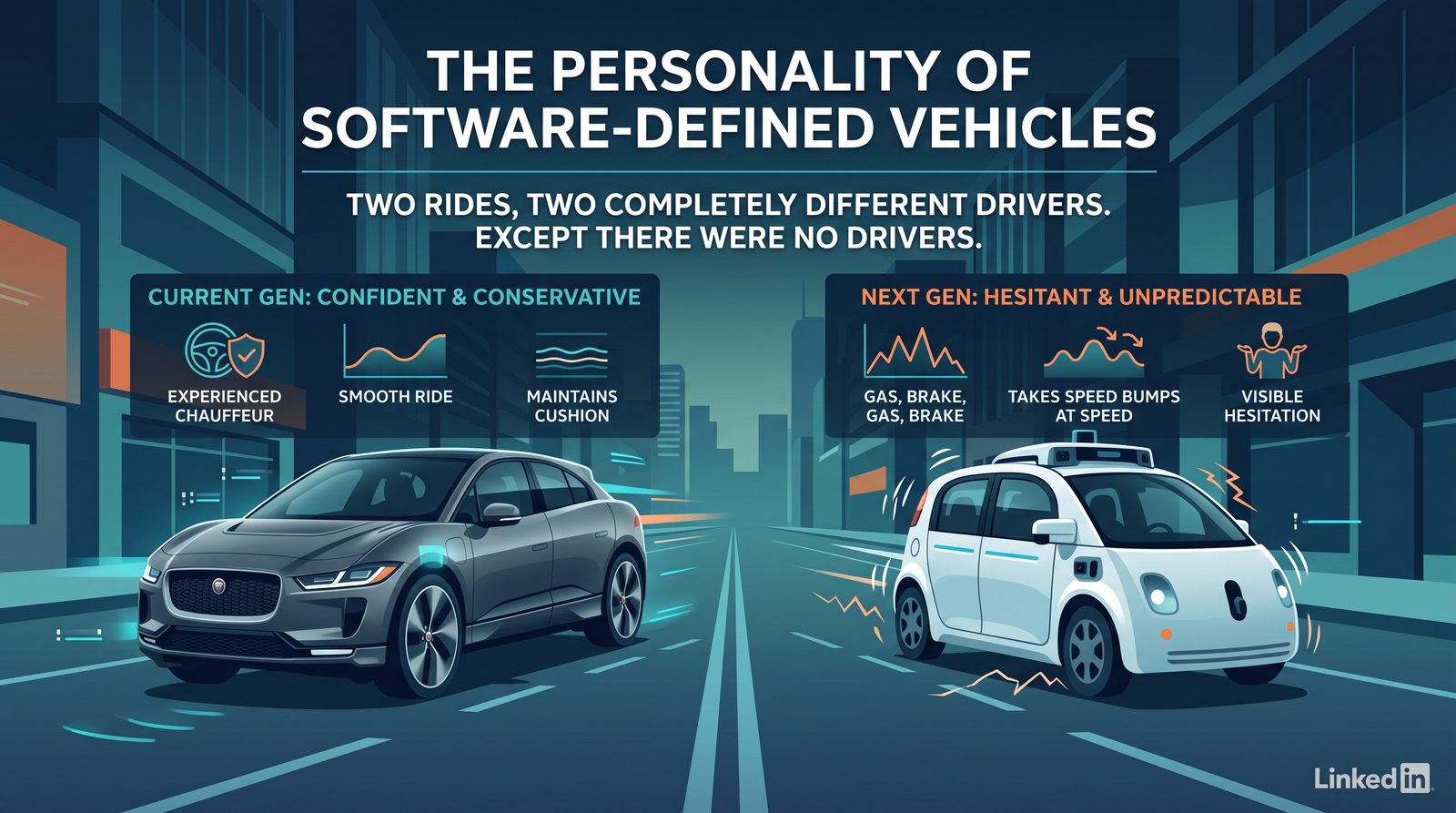
I took two Waymo rides recently. Two different generations of the same product, same company, same city, same day.
It did not feel like the same thing, much less the same product.
The current-generation Jaguar was confident but conservative. It held its position, left cushion everywhere, and quietly let the drivers around it push it around. A careful, experienced chauffeur who never says a word.
The next-generation Ojai was a teenager behind the wheel. Gas, brake, gas, brake. Speed bumps taken at speed. Stops in odd places. And when the next direction was unclear, it hesitated, visibly.
Two completely different drivers. Except there were no drivers.
That's the part worth sitting with. In a human-driven world, "generational" differences show up in hardware and styling. In an autonomous product, the entire experience is the software generation. Every model update changes the personality of the product, and the customer experiences that change as a relationship change ("who is this I'm riding with?"), not as a version number.
This is the problem every company building software-defined vehicles has inherited. When your product's behavior is defined by software iterations instead of model years, your product's generations stop being a marketing calendar and start being an identity crisis. Lucid, Tesla, Rivian: everyone shipping OTA driving behavior is now in the personality-management business.
Users don't experience your release notes. They experience your judgment.
If two rides, hours apart, feel like two different companies, which one did the customer agree to?
What's the oldest software generation still on the road in your product roadmap?