We Built a Cross-Platform UI Engine Years Before Flutter. It Didn't Matter.
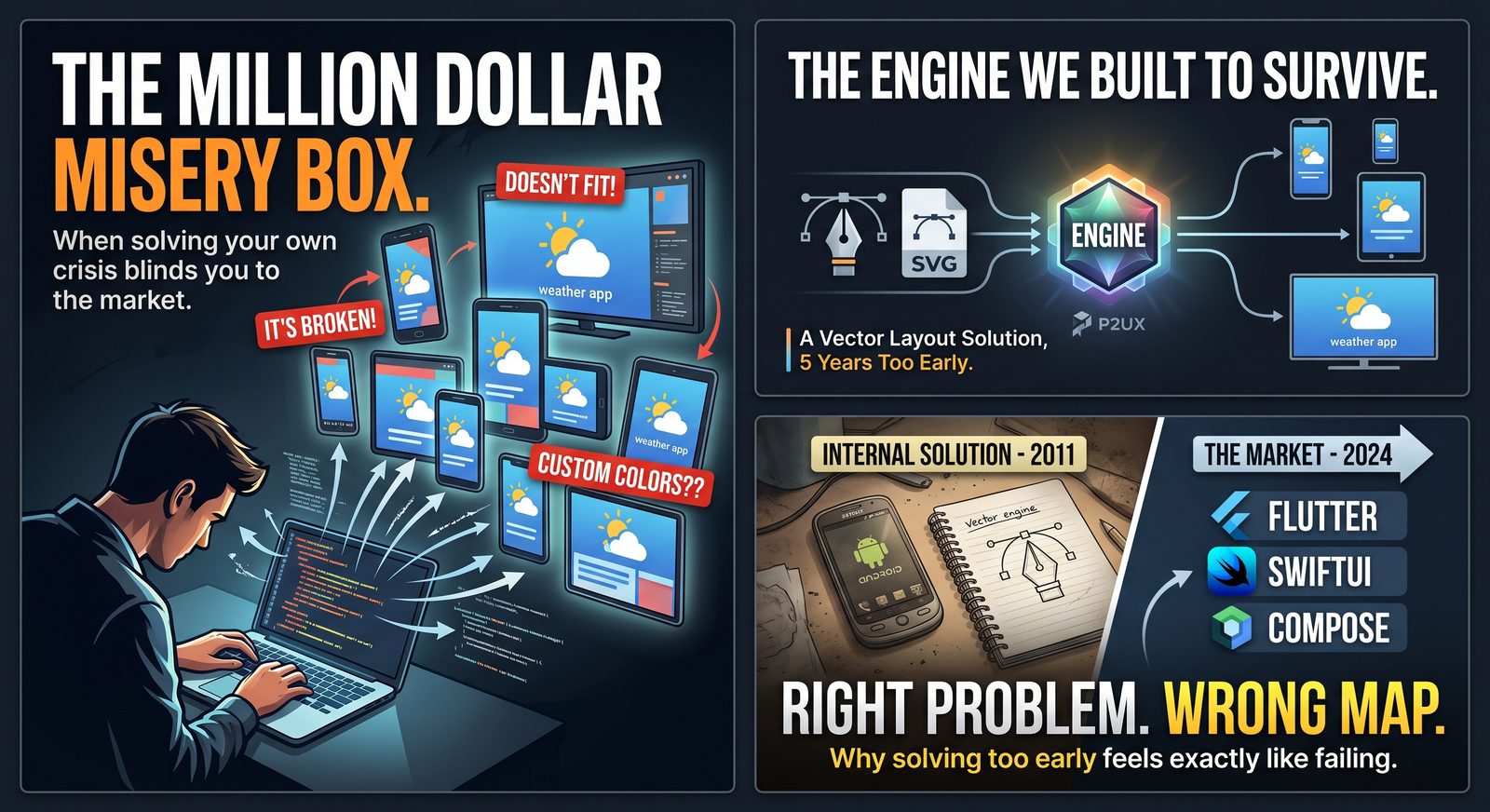
In 2011, at Phase 2, we launched Recast for Android, our own consumer weather app.
Building it was miserable. Every device had a different screen size, different resolution, different DPI. Phones, tablets, and televisions, all running the same OS. Google had nothing to help.
Every release brought the same feedback. It doesn't fit my screen. It looks funny. It's broken on my device.
We were a small company. We couldn't buy every phone, every tablet, every TV. We debugged against whatever user feedback came in that week.
And the requests were contradictory. Some users wanted realistic weather visuals. Others wanted cartoonish ones. Custom colors, custom layouts, custom everything.
So we built our way out. A layout engine driven by SVG vectors and templates instead of fixed pixels and bitmaps. One design definition that rendered across every screen, and let us iterate on graphics, fonts, and icons without touching device-specific code. It eventually became P2UX.
It took far longer than I expected. And it worked.
Years later, the market proved the problem was real. Apple shipped a kit for this. Google shipped a kit for this. Flutter. Swift. The exact solution we built, now everywhere.
Here's the part that stings: our engine was targeted at our own app and our own needs. We never looked up from our own roadmap long enough to ask whether anyone else had the same problem.
The lesson I carry from it: being right about a problem years early feels exactly like failing while you're inside it. The technology was sound. The market was invisible to us because we never checked for it.
Too early is indistinguishable from wrong, unless you're also looking outward.
What problem have you solved years ahead of the market, and never packaged?